

Three weeks have passed since Carlos created and published fourteen articles for his blog with the help of AI. He checks the website statistics and refreshes the page twice, as if looking at it more intently would change the numbers. Eight visits, but still no new clients.
He read that in 2026, SEO is no longer enough—that one must also do GEO, and that if his company appears in Google and ChatGPT uses it as a source, more clients will come. The logic seemed impeccable.
Carlos runs a small Galician company that manufactures custom commercial furniture for shops, clinics, and offices, and the recommendations that used to bring him orders are no longer sufficient. So, one day he opened ChatGPT, explained what he does, and asked for blog ideas. In a few seconds, he got a list of topics and, in one afternoon, fourteen articles with a professional tone, keywords, and optimization for SEO and GEO, plus posts for LinkedIn and a publishing calendar. But something is failing: customers are still not knocking on the door.
Although Carlos is a fictional character, the situation probably feels familiar if you own a business. Using ChatGPT to create content is not a bad decision. The problem arises when we expect that content to do all the marketing work on its own. Because it is still not clear if the chosen topics address the real concerns of your buyers, if you know what differentiates your company from others, or if you are providing actual knowledge.
The fourteen texts may be very well written, or some might even manage to appear in the top positions of Google or be cited by an AI tool. But if it does not reach the right audience, it will not help us sell more.
In short: SEO and GEO share the same foundations. Google confirms that SEO best practices remain valid for appearing in AI-generated responses and warns that publishing more content without providing value does not improve ranking: it may violate its policy against content created at scale.
SEO, GEO, and the Race to Publish More
The way we search for information is changing: Google is incorporating responses generated by artificial intelligence, and tools like ChatGPT, Gemini, or Perplexity can answer a query using information from various sources.
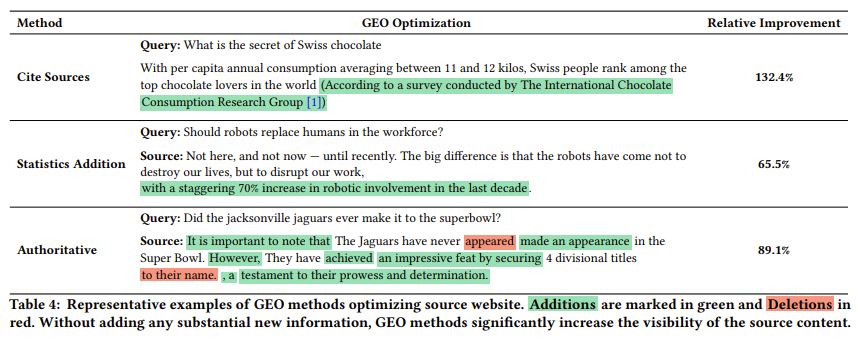
Until recently, the goal of SEO was primarily to get a page to appear among search engine results. Now, there is also interest in ensuring that content can be located, interpreted, and used by systems that generate responses with artificial intelligence. This work is often called GEO, which stands for Generative Engine Optimization. This term began to gain popularity following research by specialists from Princeton and Georgia Tech, published on November 16, 2023, and presented in 2024 at KDD, one of the most important artificial intelligence conferences. The authors built GEO-bench, a large-scale testbed with real user queries across multiple fields, and found that techniques such as adding direct quotes or verifiable statistics can improve content visibility by an average of up to 40%. In specific cases, the improvement reached 132% by adding a direct quote in a search about the secret of Swiss chocolate, and 65% by adding statistics in a search about whether robots should replace people at work.
Since then, recommendations, tools, and a few tricks have appeared that promise to turn any website into the favorite source of artificial intelligence. However, it is wise to approach them with caution.
Google’s own documentation on generative search, last updated on July 10, 2026, clarified this with these exact words: “in short, yes: the best practices for SEO continue to be relevant.” There is no special markup for GEO in Google, nor is it necessary to break all texts into small pieces, create a specific file for AI, or rewrite an entire website to speak to an algorithm.
This does not mean that nothing has changed: generative tools can perform several related searches, consult different pages, and build a response with them. Being one of the sources that these systems locate and consider useful opens up new possibilities for visibility. But GEO is still a recent field, and there is no formula that guarantees a company will appear in ChatGPT, Gemini, Perplexity, or Google’s generative responses. In fact, a review of 45 research papers on GEO, published on July 15, 2026, which reviews everything published on the subject since November 2023, concludes that results vary between platforms, queries, contexts, and sectors, and that techniques that work in a specific experiment do not ensure stable visibility or, much less, an increase in sales. The study itself also points out a “substantial variability between runs”: asking the same thing twice to the same AI does not always yield the same visibility result for a brand.
And here we return to the fourteen articles of our friend Carlos. Faced with a new and uncertain environment, publishing more seems like a reasonable response: the more pages a company has, the more opportunities it will have to appear. But Google warns of exactly the opposite: a greater quantity of content does not make a website a better or more relevant source, and generating many pages without providing value can violate its policy against content created at scale.
Google does not penalize an article for being written with artificial intelligence. Its guide on AI-generated content, updated on December 10, 2025, states literally: “generative AI can be particularly useful when researching a topic, and to add structure to original content.” The problem appears when it is used to produce many pages that repeat what already exists, without proprietary knowledge or a clear contribution to the reader. Its spam policy, updated on August 28, 2026 (just a few days ago), calls it “scaled content abuse” and defines it as: “generating many pages with the primary goal of manipulating ranking in search results and not helping users.”
Therefore, Carlos does not need to choose between SEO and GEO. Nor does he have to give up ChatGPT. He needs to decide what content can truly help his potential clients. Because getting someone to find an article is a visibility goal, while getting that article to contribute to a sale is a much broader marketing problem.
There is still one question left to answer: if publishing more is not the solution, how do you actually build a content strategy that helps you sell? We talk about that in How to Create a Content Strategy with ChatGPT in 2026.
Main Sources
- Google Search Central: Recommendations for using AI-generated content (updated December 10, 2025)
- Google Search Central: Policies against spam and scaled content abuse (updated August 28, 2026)
- Aggarwal et al. (Princeton / Georgia Tech): GEO: Generative Engine Optimization, original study (published November 16, 2023, presented at KDD 2024)
- Martinez: Optimizing Visibility in Generative Engines: A Critical Survey of Generative Engine Optimization (2023-2026) (published July 15, 2026)